


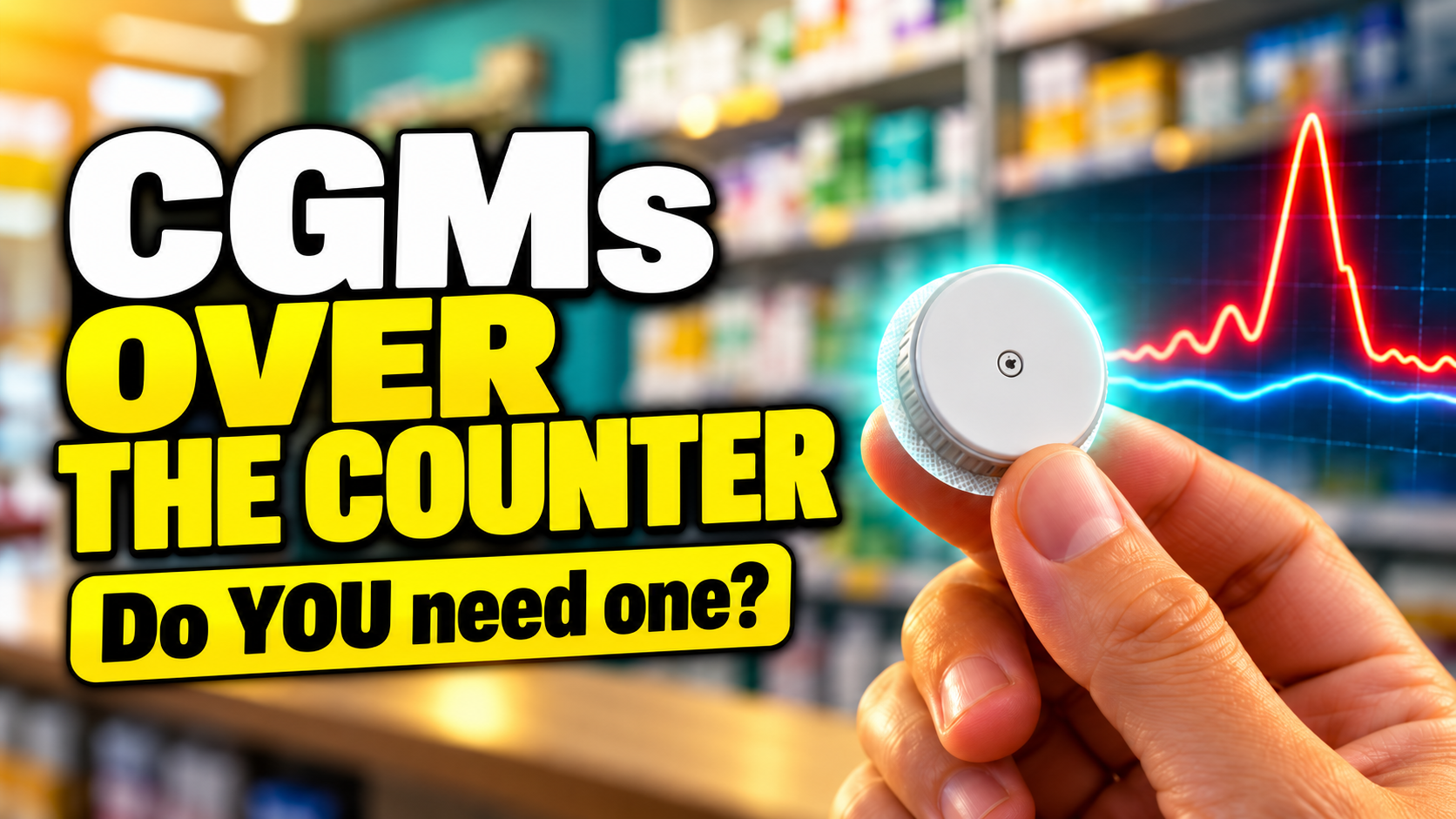
Continuous glucose monitors used to be medical equipment. You needed a prescription, a diagnosis, and usually a reason your doctor could point to.
That changed in 2024. Dexcom’s Stelo and Abbott’s Lingo both received FDA clearance as over-the-counter continuous glucose monitors — no prescription, no diabetes diagnosis required.[1][2] At almost the same moment, “blood sugar spikes” became one of the most talked-about topics in wellness content, and glucose monitors started showing up on people who have never had a blood sugar problem in their lives.
So is this a genuine health upgrade or a sensor looking for a problem to solve? Here are seven questions worth answering before you buy one.
1. What exactly changed, and which devices are actually over-the-counter?
Two products opened up this market. The FDA cleared Dexcom’s Stelo Glucose Biosensor System in March 2024 as the first OTC CGM, intended for adults with or without diabetes who do not use insulin.[1] Abbott’s Lingo followed in June 2024, cleared specifically for people who do not have diabetes and want to track how their blood sugar responds to food, sleep and exercise.[2]
Both are worn as a small sensor patch on the back of the upper arm, read glucose from fluid just under the skin, and sync to a phone app. Neither requires a doctor’s visit to buy. That is the entire regulatory change: a device category that used to sit behind a prescription now sits on a drugstore shelf.
2. Why is everyone suddenly talking about blood sugar?
The OTC launch landed in the middle of a cultural moment that was already building. French biochemist Jessie Inchauspé, known online as the “Glucose Goddess,” turned glucose-spike management into a mainstream wellness topic through books and social content, popularizing habits like eating food in a specific order and taking a short walk after meals.
That messaging primed millions of people to think about glucose even without a meter. The OTC approval gave them a way to actually watch the number move — which is part of what makes this trend different from most wellness fads: it comes with a real, purchasable device attached.
3. What does a glucose spike actually do to your body?
The biology, briefly
When you eat carbohydrates, they break down into glucose, which enters your bloodstream. Your pancreas releases insulin to move that glucose into your cells for energy or storage. A “spike” is a sharp, fast rise in blood glucose followed by a steep drop as insulin does its job — as opposed to a slower, flatter rise and fall.
Why variability, not just the peak, matters
The concern isn’t only how high glucose climbs after one meal. A large prospective study of more than 46,000 adults found that people with more visit-to-visit variability in their fasting blood glucose had a meaningfully higher lifetime risk of cardiovascular disease than people with stable readings — a 32.5% lifetime risk versus 26.3% — even though none of the participants were on diabetes medication at the start of the study.[3] That’s evidence that glucose swings, not just diabetes itself, are worth paying attention to.
The 3pm crash you already know
The more familiar version of this is the post-lunch slump: the heavy, foggy, suddenly-starving feeling an hour or two after a carb-heavy meal. That’s the downside of the spike — the crash that follows it — and it’s the symptom most people actually notice, long before they ever think about a monitor.
4. Does the research actually support wearing one if you’re not diabetic?
This is where the honest answer gets less exciting than the marketing. Healio’s endocrinology desk reported in late 2025 that CGM data may hold promise for people without diabetes, while stressing that the evidence to support routine use in that group is still thin and more research is needed before anyone can say it changes health outcomes.[5]
Harvard Health’s review of the evidence is more blunt. Dr. Robert Shmerling, writing for the Harvard Health Blog, notes that in the best available study of non-diabetic people, glucose stayed in the normal range about 96% of the time, and many of the “abnormal” readings were implausible rather than meaningful.[4] His conclusion: “I could find no published study suggesting that monitoring translates into improved health for healthy people without diabetes.”[4] He also flags a real downside — false alarms and ambiguous dips that cause anxiety or prompt people to snack more, not less.[4]
Translation: a CGM can show you real data. What it can’t yet do, for someone without diabetes, is promise that acting on that data will make you healthier.
5. Do the “fix the spike” habits from social media actually work?
Eating protein and vegetables before carbs
This one has real research behind it, with a caveat. A small study from Weill Cornell Medicine, published in Diabetes Care, had people with type 2 diabetes eat the same meal on two occasions — once carbs-first, once vegetables and protein first. Eating in that order lowered post-meal glucose by roughly 29% at 30 minutes and 37% at 60 minutes, with lower insulin levels too.[6] The study was done in people who already had type 2 diabetes, not a general wellness population, but the mechanism — slowing carbohydrate absorption — applies more broadly.
Walking after eating
A University of Otago trial, published in Diabetologia, found that three 10-minute walks after meals lowered blood sugar more effectively than one 30-minute walk at another time of day, with the post-dinner walk making the biggest difference.[7] Again, the study population had type 2 diabetes, but a short post-meal walk is low-risk and low-cost advice that’s easy to test on yourself regardless.
“Healthy” labels can be misleading
Instant oatmeal, dried fruit and fruit smoothies often have a higher glycemic impact than their health-food reputation suggests, because processing and concentrated sugars make glucose easier and faster to absorb than in whole, less-processed versions of the same food. A monitor can make that visible in a way a nutrition label alone doesn’t.
Aim for fewer extreme swings, not a flat line
There is no established “ideal” glucose curve for a non-diabetic person to chase, and Harvard Health is explicit that an optimal target hasn’t been defined for this group.[4] The more defensible goal, based on what the research above actually shows, is fewer sharp spike-and-crash cycles — not a perfectly flat line, which isn’t a realistic or necessary target for someone without diabetes.
6. How much does it cost, and is a short trial enough?
OTC CGMs are a recurring cost, not a one-time purchase — sensors are typically replaced every one to two weeks, and Harvard Health notes the ongoing cost can run into the thousands of dollars a year, with insurance unlikely to cover non-medical use.[4]
Given the current evidence, a two-to-four-week trial is a more reasonable way to use one than an open-ended subscription. That’s long enough to see how your own body responds to your actual meals, workouts and sleep, and short enough that you’re not paying indefinitely for a number with no proven health benefit attached.
7. What should you ask before you buy one?
If you’re still deciding, these questions are more useful than whatever a sponsored post tells you:
- Do I have a specific question I want the data to answer, or am I curious in general?
- Am I willing to treat a single reading as noise rather than a diagnosis?
- Can I afford several weeks of sensors without treating it as a permanent subscription?
- Do I have a condition (prediabetes, PCOS, a strong family history of diabetes) that would make this worth discussing with a clinician first?
- Will I actually change a habit based on what I see, or just feel anxious about it?
If the honest answers point to curiosity rather than a clear plan, it’s reasonable to wait, or to start with the free habits — food order, post-meal walks, watching which “healthy” foods spike you personally — before paying for the sensor that measures them.
Watch the full breakdown
We cover this entire story — the OTC launch, the biology of a spike, the honest research caveat, and the habits worth trying — in a companion video on the Healthy Living Digest YouTube channel. [Video embed to be added once the video is live on the channel.]
Frequently asked questions
Do I need a prescription to buy a continuous glucose monitor now?
No, not for the OTC-cleared devices. Dexcom Stelo and Abbott Lingo are both FDA-cleared for over-the-counter sale to adults without a prescription.[1][2] Prescription CGMs for people who use insulin remain a separate category.
Is a glucose spike dangerous if I don’t have diabetes?
An occasional spike after a large meal is normal and not a medical emergency. The concern in the research is long-term glucose variability, not any single spike — and that link to cardiovascular risk has mostly been studied in large population data, not proven to be changed by wearing a monitor.[3]
What’s the difference between Dexcom Stelo and Abbott Lingo?
Stelo is cleared for adults with or without diabetes who don’t use insulin, while Lingo is positioned specifically for people without diabetes who want to track how food, sleep and exercise affect their glucose.[1][2] Both use an arm sensor and a companion app; the practical differences are mostly in app design and interpretation features.
How long should I wear one if I’m just curious?
Two to four weeks is enough to see patterns across different meals, workouts and sleep, without committing to an open-ended subscription for a device whose long-term benefit in non-diabetics isn’t yet established.[4]
The bottom line
The OTC approval is real and the biology behind glucose spikes is real. What’s still unproven is whether wearing a monitor — as opposed to simply practicing the habits a monitor might teach you — makes a healthy person measurably healthier. The research so far says: maybe useful, not yet proven, and not a replacement for a conversation with your doctor if you have risk factors for diabetes.
This article is for general education and isn’t medical advice. Talk to your doctor before starting to use a glucose monitor or changing your diet based on one, especially if you have or are at risk for diabetes.
If you’re more worried about where your blood sugar already stands, our guide to the warning signs of prediabetes is a good next read.
For more evidence-led healthy-living guides, visit healthylivingdigest.com.
Sources
[1] Healio: FDA clears first OTC CGM for adults with and without diabetes who do not use insulin
[2] MedTech Dive: Abbott wins FDA clearance for Lingo, an over-the-counter CGM
[3] PMC: Visit-to-visit fasting blood glucose variability and lifetime risk of cardiovascular disease
[4] Harvard Health Blog: Is blood sugar monitoring without diabetes worthwhile?
[5] Healio: CGM may be beneficial for people without diabetes, but more research needed
[6] PMC: Food Order Has a Significant Impact on Postprandial Glucose and Insulin Levels (Diabetes Care)
[7] Diabetologia: Advice to walk after meals improves glycaemic control in type 2 diabetes
