


Online vitamin D advice has a numbers problem. One person says 400 IU. Another recommends 800 IU. Then a podcast guest or supplement advert jumps to several thousand IU and calls it “optimal.”
Those figures may describe different things. One might be a total daily intake, another a routine supplement, and another a treatment dose intended for someone with a diagnosed deficiency. They may also come from different countries, age groups or clinical guidelines.
Vitamin D after 50 does not come with one universal prescription. A careful review is still worthwhile because skin becomes less efficient at making vitamin D with age.[3][5] Check the context before copying somebody else’s routine.
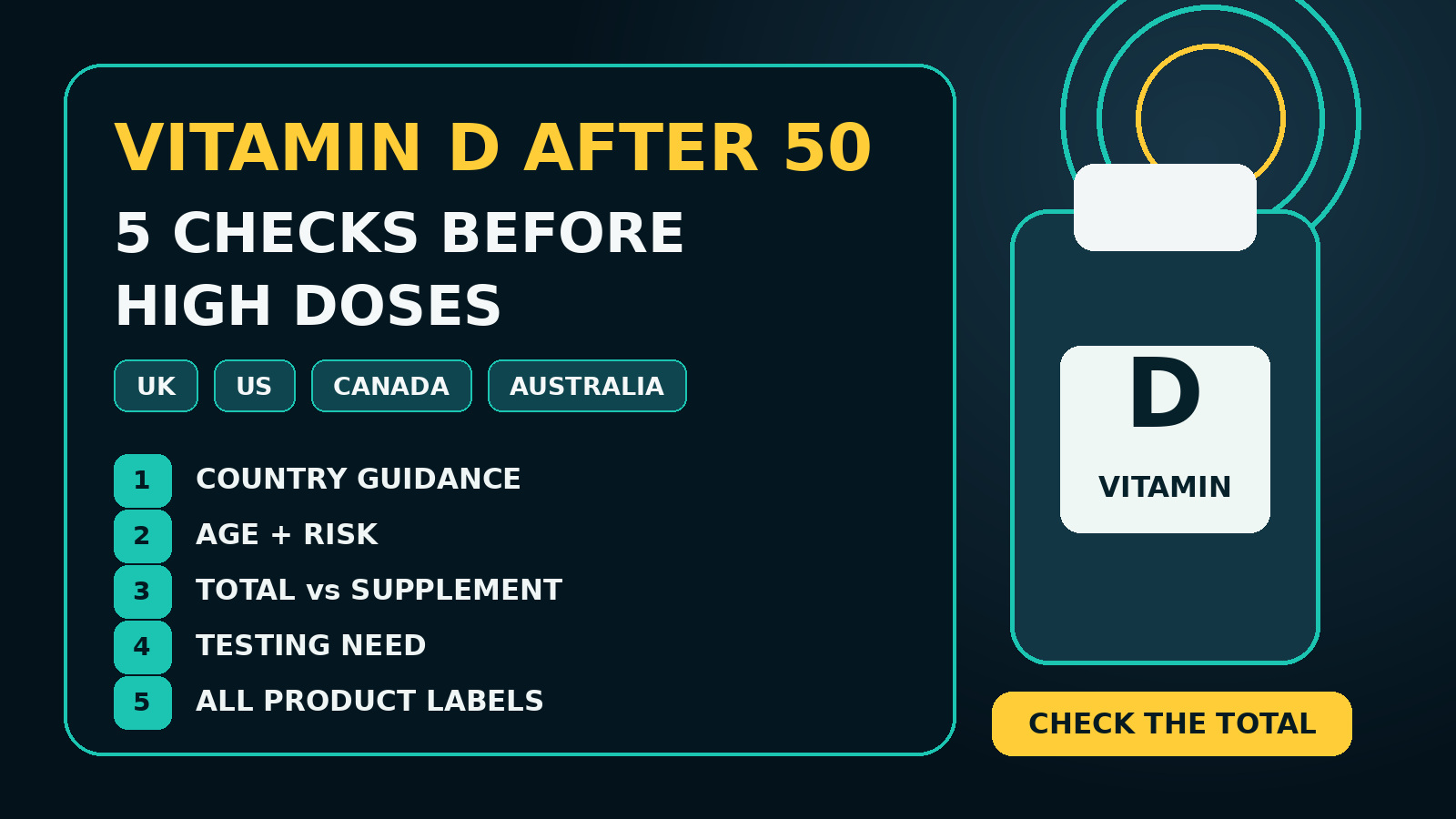
These five checks will help you do that.
1. Check which country’s guidance you are reading
Vitamin D guidance reflects local seasons, food fortification, sunlight and public-health policy. A recommendation from one country should not be presented as a worldwide rule.
United Kingdom
The NHS says adults need 10 micrograms, or 400 IU, of vitamin D a day. It advises everyone to consider a daily 10-microgram supplement during autumn and winter, when sunlight in the UK is not strong enough for most people to make enough vitamin D through their skin.[1]
Some people are advised to consider that amount throughout the year. The NHS includes people who are frail or housebound, live in a care home, rarely go outdoors, cover most of their skin outside or have dark skin.[1]
That is UK guidance. It should not be exported unchanged to a country with different sunlight, fortification and health policy.
United States
The US National Institutes of Health lists a recommended dietary allowance of 15 micrograms, or 600 IU, for adults aged 51 to 70. The figure rises to 20 micrograms, or 800 IU, after age 70.[3]
These figures describe total daily intake, not an instruction that every person should buy a tablet containing that exact amount. Food, fortified products and supplements all contribute.
The US-based Endocrine Society’s professional guideline adds another age boundary. It advises generally healthy adults under 75 to follow the standard recommended intake rather than routinely taking more. For people aged 75 or older, it conditionally suggests empiric supplementation and prefers a lower daily dose to intermittent high-dose schedules.[4]
The age cut-offs matter. “After 50,” “over 70” and “75 or older” are not interchangeable categories.
Canada
Health Canada gives adults aged 51 and older a clear supplement message: take a daily supplement containing 400 IU, or 10 micrograms, while continuing to eat foods that contain vitamin D.[2]
This is a useful example of why labels must be read carefully. A recommended supplement amount is not necessarily the same as the reference value for total daily intake. If a person treats every number as a separate target and adds them together, the result can be much higher than intended.
Australia
Healthdirect lists recommended amounts from food of 10 micrograms a day for adults aged 51 to 70 and 15 micrograms for those over 70.[5]
Australian advice gives sunlight a larger role than northern-hemisphere winter guidance. Most vitamin D is made in the skin, but the goal is not unlimited sun. Healthdirect advises balancing vitamin D production with protection from harmful ultraviolet radiation and skin cancer.[5]
Start with guidance for where you live. Do not average the four figures or pick the highest.
2. Check your age band and risk factors
Age matters, but a birthday is only one part of the picture.
Older skin is less efficient at making vitamin D. Risk can also rise when someone spends little time outside, is frail or housebound, lives in residential care, wears clothing that covers most of the skin, or has darker skin.[1][5]
Health conditions can change the advice as well. Healthdirect lists advanced kidney disease and conditions that limit fat absorption among situations linked with vitamin D deficiency.[5] Symptoms, risk factors and conditions affecting vitamin D may give a clinician a reason to test.[5]
None of these factors proves that a person is deficient. They tell you that a generic internet routine may be a poor fit.
There is also a difference between prevention and treatment. Public-health guidance is written for broad groups of generally healthy people. A clinician treating confirmed deficiency may use a different dose for a defined period, with follow-up based on the person’s condition.[5] That treatment plan should not be copied by someone who has never been assessed.
Before changing your routine, ask:
- Which age band applies to me?
- Do I have a condition that affects absorption, calcium or bone health?
- Am I taking a medicine that could change the advice?
- Do I get little outdoor exposure?
- Am I following general guidance or a clinician’s treatment plan?
Those questions are more useful than asking what dose a stranger takes.
3. Check whether the number means total intake or supplement dose
Vitamin D amounts are usually written in micrograms or international units. The conversion is fixed:
1 microgram of vitamin D equals 40 IU.[1][3]
That means:
- 10 micrograms equals 400 IU
- 15 micrograms equals 600 IU
- 20 micrograms equals 800 IU
- 100 micrograms equals 4,000 IU
Conversion is the easy part. First check whether the figure means total intake, a supplement dose or treatment.
A total-intake recommendation includes vitamin D from food, fortified foods and supplements. A supplement recommendation tells you what to take in a product, often alongside food. A prescribed treatment dose is different again.
Food can contribute. The NHS lists oily fish such as salmon, sardines and mackerel, along with fortified foods, as useful sources.[7] The exact contribution depends on the food, portion and fortification rules in your country.[7]
This is why a bottle cannot be interpreted in isolation. A 400-IU tablet might sit alongside a multivitamin, fortified cereal and another bone-health product. The front labels may look different, but the vitamin D still adds up.
Use one unit when comparing products. If one bottle uses micrograms and another uses IU, convert them before calculating the total. Do not add a new product until you know what you already take.
4. Check whether a blood test is actually indicated
Vitamin D is assessed using a blood test for 25-hydroxyvitamin D, often shortened to 25(OH)D.[5][6] Online discussions sometimes treat this as a routine annual score or a way to find a personal “optimal” level. Official guidance is more cautious.
The US Preventive Services Task Force says evidence is insufficient to determine the balance of benefits and harms of screening asymptomatic adults for vitamin D deficiency.[6] That does not mean testing is useless. It means there is not enough evidence to recommend routine screening for everyone without symptoms or another clinical reason.
The Endocrine Society also suggests against routine 25(OH)D testing in generally healthy adults aged 75 or older when discussing empiric supplementation. It notes that trials have not established a blood-level threshold that delivers specific disease-prevention benefits for this group.[4]
Testing can still be appropriate. Symptoms, risk factors and conditions affecting vitamin D may give a clinician a reason to test.[5]
Ask whether the result would change your care.
A social-media target range should not replace clinical interpretation. Laboratory methods and thresholds can vary.[6] The result needs to be read alongside symptoms, medical history, medicines and the reason the test was ordered.
5. Check the total dose across every product
Check every source. Vitamin D may appear in:
- a multivitamin
- a calcium or bone-health product
- cod-liver oil
- a menopause or “healthy ageing” blend
- a standalone vitamin D tablet or spray
- a prescribed preparation
Write down the amount from every product and convert it into the same unit. Then add the figures once. This catches accidental stacking, which is easy to miss when one bottle uses micrograms and another uses IU.
The NHS warns adults not to take more than 100 micrograms, or 4,000 IU, of vitamin D a day because it could be harmful.[1] That figure is an upper limit, not a target and not evidence that 4,000 IU is better than 400 or 800 IU.
A clinician may prescribe a different regimen to treat confirmed deficiency for a set period and review it afterwards.[5] That does not make the same regimen suitable for long-term self-treatment.
High-dose routines deserve extra scrutiny when they use weekly or monthly megadoses, claim to prevent unrelated diseases, or rely on a single blood result without explaining the person’s medical context. The Endocrine Society’s guidance for adults aged 75 or older specifically prefers daily lower-dose supplementation over non-daily higher-dose schedules.[4]
Five questions to take to a pharmacist or clinician
If the labels and country guidance still leave you unsure, take the actual bottles or clear photographs of the labels to a pharmacist or clinician. Ask:
- Which local guidance applies to my age?
- Do my health conditions or medicines change the advice?
- How much vitamin D am I already getting from all products?
- Is a blood test indicated for me?
- If treatment is needed, how long should the dose continue and when should it be reviewed?
The bottom line
Vitamin D advice after 50 is not a competition to find the biggest number. The right starting point is current guidance for your country, followed by your age band, risk factors, existing products and any clinical reason for testing or treatment.
Check the total before adding another supplement. Treat upper limits as boundaries, not goals. If a clinician has prescribed vitamin D for a confirmed deficiency or another condition, follow that plan rather than replacing it with general internet advice.
For more evidence-led healthy-living guides, visit healthylivingdigest.com.
Frequently asked questions
Is 4,000 IU of vitamin D a recommended daily target?
No. The NHS cites 4,000 IU, or 100 micrograms, as the adult daily upper limit. It is not a routine target.[1]
Should everyone over 50 take vitamin D?
Advice differs by country and age.[1][3][5]
Health Canada explicitly advises adults aged 51 and older to take a daily 400-IU supplement, while other countries frame routine supplementation differently.[2]
Do I need a vitamin D blood test before taking a supplement?
Not automatically. The USPSTF says the evidence is insufficient to assess routine screening of asymptomatic adults, while the Endocrine Society suggests against routine testing in generally healthy adults aged 75 or older.[4][6] Symptoms, risk factors and medical conditions can change the decision.[5]
Sources
[1] NHS: Vitamin D
[3] NIH ODS: Vitamin D — Health Professional Fact Sheet
[4] Endocrine Society: Vitamin D for Prevention of Disease
[5] Healthdirect Australia: Vitamin D and your health
