


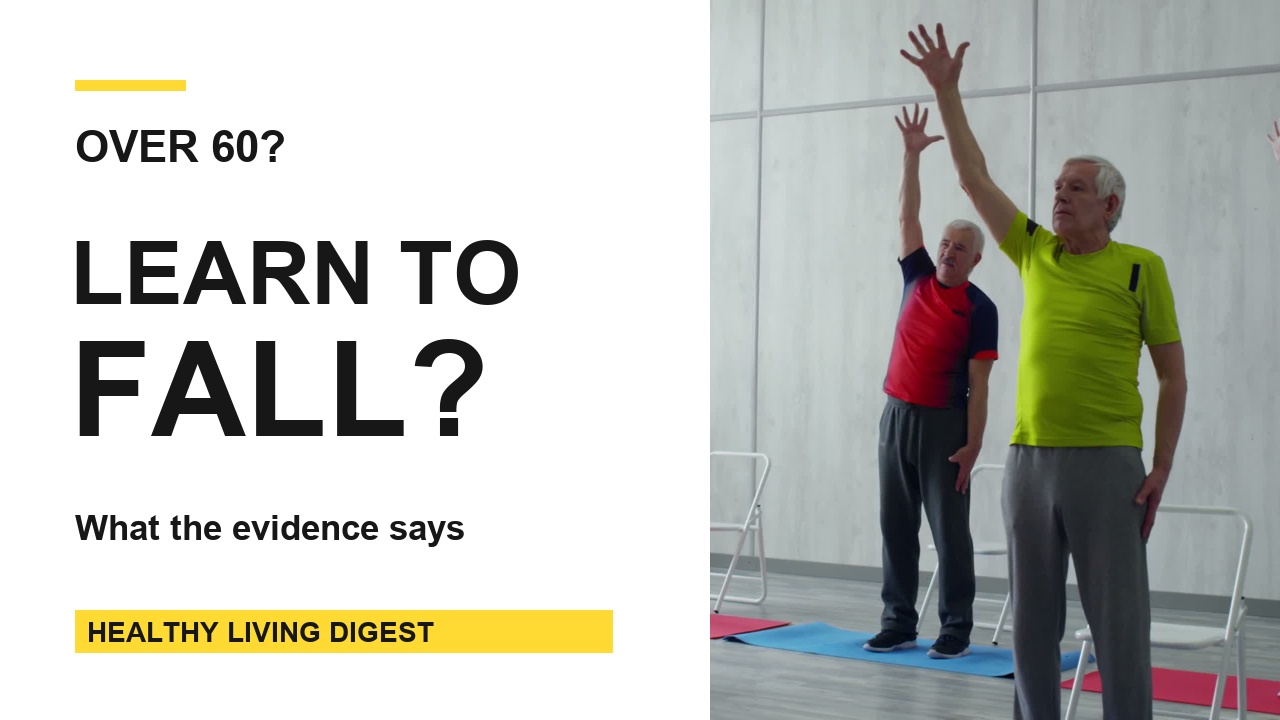
Can judo help people over 60 learn to fall more safely? It is an appealing idea: alongside working on balance, could we learn skills that might help when a fall happens?
Adapted judo programmes show promise for improving practised falling skills and some aspects of physical function. That does not yet establish that judo prevents fractures or serious injuries in everyday life. The programme, instructor and individual participant all matter.
Here is what the research can tell us, what remains uncertain and what to ask before joining a class.
Watch: Over 60 — Can Judo Help You Fall More Safely?
Prefer to watch in the app? Watch the full Healthy Living Digest video on YouTube.
What does adapted judo after 60 involve?
“Judo” can bring competitive throws and fast-paced contests to mind. A programme designed around older adults and safer falling has a different purpose. It may combine balance, strength, coordination and progressively taught landing skills, with activities adjusted to participants.
For example, British Judo’s Finding Your Feet programme focuses on safer falling. Its existence is useful context when looking for UK provision, but a programme’s stated aim should not be confused with independent proof that it reduces injuries.
The key word is adapted. A standard adult judo session is not automatically an appropriate safer-falling class for an older beginner. Ask exactly what is taught, how you will be assessed and how the instructor changes activities for different abilities.
What does the research actually show?
The distinction to keep in mind is between performing a skill during a supervised assessment and avoiding an injury during an unexpected fall outside the class. Both matter, but they are different outcomes.
Judo4Balance: encouraging skills findings, with an important interruption
A 2022 Judo4Balance study initially randomised 200 community-dwelling older adults, with an average age of 72. It examined physical function and safe-landing skills. COVID-19 interrupted the original intervention; when the programme restarted, both groups were offered training.
The researchers reported improvements in assessed skills and physical function. However, the interruption complicates interpretation of the original trial design. These findings should not be presented as proof that participants subsequently had fewer fractures or serious fall injuries.
A small feasibility study: useful, but not a definitive safety test
A 2024 feasibility study involved 17 adults aged 66–87 in an eight-week, supervised judo-based programme. Measures of mobility, balance and physical performance improved. There were no serious adverse events reported, but the study had no control group and was small.
That makes it helpful for understanding whether a programme can be delivered, rather than establishing that every older adult can participate safely. The authors emphasised supervision and individualisation.
Newer research also measures fall competence
A 2025 study of Adapted Utilitarian Judo compared 22 women in a training group with 23 in a control group. After 12 sessions, the training group improved assessed backward and sideways fall competence.
This was a quasi-experimental study using a convenience sample, rather than a large randomised trial. It adds evidence about learning skills under assessment; it does not establish fewer real-world fractures.
Does judo prevent falls? Keep the wider exercise evidence separate
There is stronger evidence that appropriate exercise can reduce falls among older people living in the community. A Cochrane review found that exercise reduced the rate of falls by about 23% across the studies contributing to that outcome. Balance and functional exercise were particularly useful.
The 23% figure is for exercise programmes overall, not judo alone. It describes the rate of falls over time, not a 23% reduction in fractures or a guarantee for an individual.
Think of adapted judo as an option to discuss within the wider picture of staying active and addressing your own fall risks. It should not displace a suitable strength-and-balance programme or an assessment when one is needed.
Five questions to ask before a safer-falling class
Use these questions to establish what the class actually offers. The answers should be specific to you, rather than a promise that everyone will benefit.
- Do you have experience teaching older beginners? Ask about relevant qualifications and experience with adapted safer-falling sessions.
- What assessment happens before I start? Explain your mobility needs, previous falls and relevant health concerns, and ask when clinical advice is required.
- How are activities adapted? Find out how progression works and whether you can pause or use an alternative activity.
- What is the setting? Ask about suitable mats, supervision, group size and help if someone feels unwell.
- Is this specifically a safer-falling programme? Check whether the session is designed for that purpose and how it differs from general or competitive judo.
Watching a class or speaking to its instructor beforehand can help you decide whether its approach feels appropriate. You should understand what participation involves before attempting an activity.
If you have fallen or feel unsteady, start with advice
The NHS advises speaking to a GP if you have had a fall or are worried about balance or mobility. A falls assessment can look beyond exercise, including medicines, eyesight, bone health and hazards at home.
NICE’s falls guidance supports approaches matched to a person’s risks and needs, including appropriate exercise programmes that address balance, coordination, strength and power. It is not a blanket recommendation for everyone over 60 to take up judo.
Do not deliberately practise falls at home after watching a video. This article and our film explain the topic; neither is a practical falling lesson. If you are interested, discuss a suitable supervised programme with an appropriately qualified professional.
After a fall, call 999 if you cannot get up or may have injured your head, back, neck or hip. See the NHS falls page for further guidance.
For broader activity ideas, explore our guide to building an exercise routine. Choose activities and progression that fit your circumstances.
Judo for older adults: common questions
Am I too old to start judo after 60?
Age alone cannot tell you whether a particular class is suitable. Research has included participants in their 60s, 70s and beyond, but those supervised study settings do not establish suitability for everyone. Your health, mobility and the programme’s adaptations matter.
Will learning to fall safely stop me breaking a bone?
No programme can promise that. Improved assessed landing skills are encouraging, but the studies discussed here do not establish a reduction in real-world fractures. Bone health and other fall risks still need attention.
Can I learn safer falling from a YouTube tutorial?
A video can help you understand the idea and prepare questions. It cannot assess you, provide suitable mats or supervise progression. Use our film as background for a conversation about an appropriate class.
Where can I find a class in the UK?
Start by asking British Judo about its safer-falling provision and local availability. Confirm that the instructor works with older beginners and that the specific class can meet your needs.
Explore the full story with Healthy Living Digest
Judo after 60 is an interesting possibility, with promising research on learnable skills and important questions still unanswered. The useful next step is to understand those limits and ask about a programme suited to you.
Watch “Over 60: Can Judo Help You Fall More Safely?” on Healthy Living Digest’s YouTube channel for the full explanation.
Evidence checked: 1 November 2026. General health information, not personalised medical advice. Research links above identify the selected studies and guidance used.
