


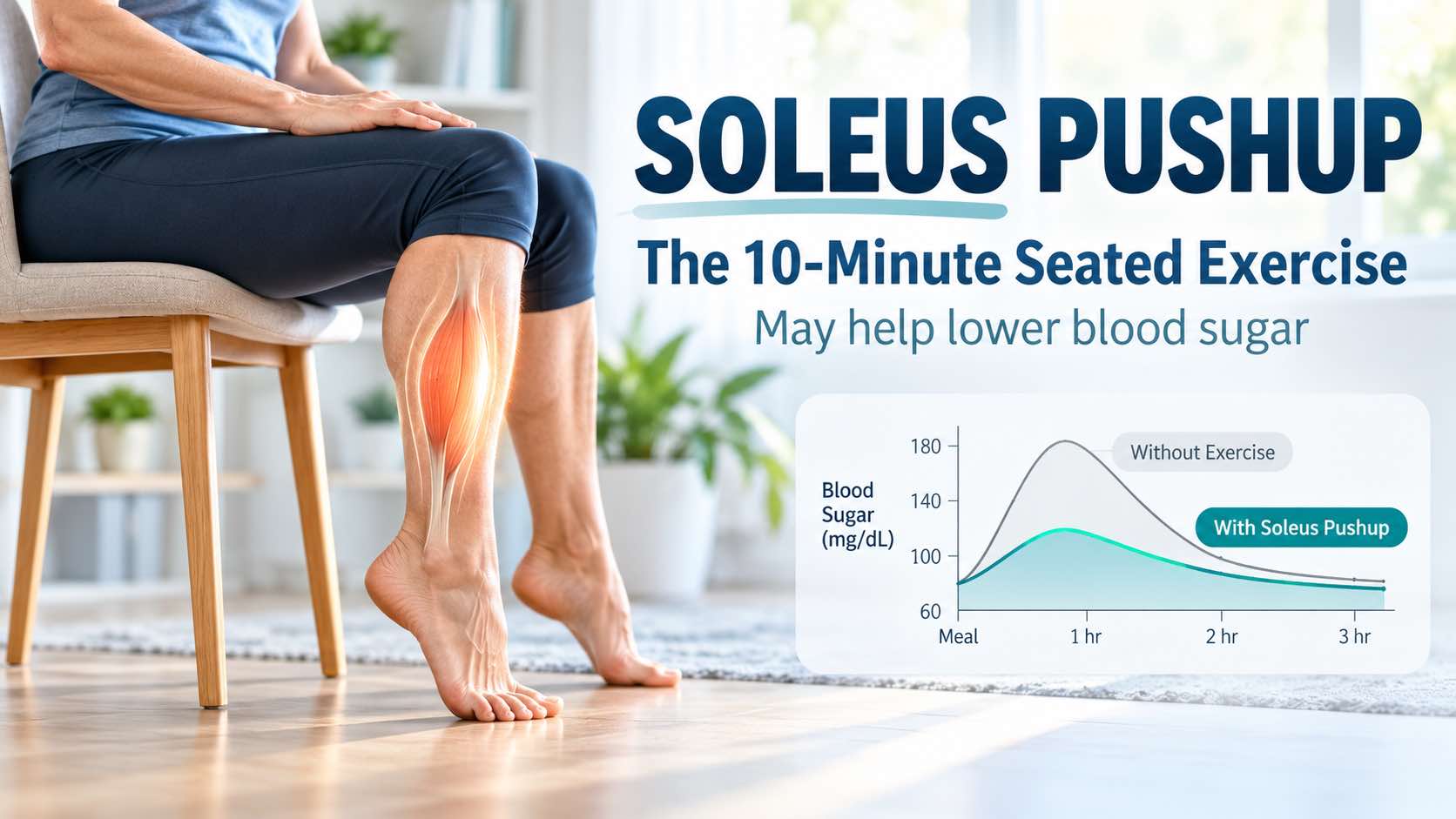
If you spend most of your day sitting, there is a small, overlooked muscle in your lower leg that researchers say may matter more for your blood sugar than any other muscle in your body. It’s called the soleus, and a study out of the University of Houston found that activating it with a simple seated exercise — the “soleus pushup” — cut post-meal blood sugar spikes by 52% and reduced the amount of insulin the body needed by 60%, without requiring you to stand up, walk, or go to the gym.
This article is for general information only and is not medical advice. Talk to your doctor before changing your exercise routine, especially if you have diabetes or take glucose-lowering medication.
What Is the Soleus Pushup?
The soleus is the calf muscle that sits beneath the more visible gastrocnemius, running from just below the knee down to the heel. Unlike most muscles, researchers found the soleus can be trained to rely almost entirely on oxidative metabolism — meaning it burns through sugar and fat for fuel continuously, for hours, without fatiguing the way other muscles do during normal exercise.
The “soleus pushup” (SPU) is the specific seated movement researchers used to activate it:
- Sit with your feet flat on the floor and the rest of your leg muscles relaxed.
- Keeping the front/ball of your foot planted, raise your heel as high as comfortable.
- At the top, let the heel drop back down passively — don’t actively lower it, let gravity do the work.
- Repeat in a slow, steady rhythm.
Done correctly, this feels like very little work. That’s the point: the soleus pushup is designed to keep the muscle in a low-intensity, highly oxidative state for an extended period, not to build strength or burn calories through effort.
The Science: What the Researchers Found
The research was led by Marc Hamilton, a professor of Health and Human Performance, along with Deborah Hamilton and Theodore Zderic at the University of Houston’s Metabolic Innovations lab, and published in the journal iScience.
Their key findings:
- Blood glucose excursion (the rise and fall of blood sugar after eating or drinking glucose) improved by 52% over a three-hour window when participants performed the soleus pushup, compared to remaining seated without it.
- The amount of insulin the body needed to manage that same glucose load dropped by about 60%.
- During fasting periods, soleus pushups roughly doubled the normal rate of fat oxidation (fat burning).
- Despite making up only about 1% of total body weight, the soleus was able to double or triple whole-body carbohydrate oxidation when activated this way.
- The effect lasted for hours at a time, not just minutes — a notably longer metabolic window than a typical short walk or workout provides.
The researchers have been clear that this is a physiological finding, not a fitness fad: in their own words, optimizing it currently benefits from wearable technology and guided practice, and further work on simplified at-home instruction is ongoing.
How to Try It Safely
Based on the published protocol and guidance from clinicians who have written about it since, a reasonable way to start:
- Do it seated at a desk, during a meeting, or anywhere you’re already sitting — no equipment needed.
- Aim for slow, relaxed reps rather than fast or forceful ones; this is not a calf-raise workout.
- Try it for 10–15 minutes after a meal, when blood sugar is naturally rising, for the clearest potential benefit.
- It can be done for extended periods (an hour or more) at low intensity without the fatigue of standing exercise — but there’s no need to overdo it to get started.
Who Might Benefit Most
This research is particularly relevant to people who sit for long stretches — desk workers, frequent travelers, and anyone managing prediabetes, insulin resistance, or type 2 diabetes under medical guidance. It’s also a practical option for people who find standing exercise difficult because of joint pain, mobility limitations, or time constraints, since it can be done from a chair.
How Does It Compare to Walking After Meals?
Walking after eating is one of the best-studied ways to blunt a post-meal blood sugar spike, and it remains a great option when you’re able to do it. The soleus pushup isn’t necessarily a replacement — it’s an option for the many hours of the day when walking isn’t practical, such as during a work call, a flight, or while watching TV. Some clinicians suggest combining both: walk when you can, and use soleus pushups to extend the metabolic benefit through the rest of your sedentary time.
Caveats and Limitations
- Most of the detailed metabolic measurements in the original study were taken using lab equipment and continuous monitoring; your own results may be harder to measure precisely at home without a continuous glucose monitor.
- This is not a treatment for diabetes and should not replace prescribed medication, diet changes, or medical advice.
- Individual results vary based on fitness level, insulin sensitivity, and how consistently the exercise is performed.
- If you have a foot, ankle, or calf injury, check with a healthcare provider or physical therapist before starting.
Frequently Asked Questions
Is the soleus pushup the same as a calf raise?
Not quite. A standing calf raise works the muscle against your full body weight and is meant to build strength. The soleus pushup is done seated, with minimal effort, specifically to keep the muscle in a low-intensity, fat- and sugar-burning state for a long period.
How long do I need to do it to see a benefit?
The original research measured effects over multi-hour windows and extended, low-intensity sessions. Shorter bouts of 10–15 minutes after meals are a reasonable, practical starting point, though they haven’t been studied in isolation to the same degree.
Can this replace exercise or medication?
No. It’s a complementary habit that may help manage blood sugar between other healthy habits — not a substitute for regular exercise, a balanced diet, or prescribed treatment.
Do I need any equipment?
No equipment is required. Some people like to track progress with a fitness watch or continuous glucose monitor, but it’s entirely optional.
The Bottom Line
The soleus pushup is a rare example of a genuinely low-effort habit with real, published research behind it. It won’t replace walking, strength training, or medical care for blood sugar management — but as a free, equipment-free option for the hours you’re already sitting down, it’s worth trying.
